Best Daylight Lamp for Crafts (2026): 8 Picks Explained by Kelvin, CRI and Lux
The best daylight lamp for crafts is the Daylight Slimline 4 Floor (about $225): 6,000K color temperature, 95+ CRI and 3,200 lux at 30 cm, so floss and fabric colors look close to how they look by a sunny window. For a table, the Daylight DuoPro (about $82) offers the same 6,000K, 95+ CRI light.
A daylight lamp is a lamp whose light is close in color to midday daylight and that shows colors accurately. Two numbers tell you whether a lamp qualifies: color temperature, measured in Kelvin (K), and color rendering, measured by CRI. Our top pick, the Daylight Slimline 4 Floor at about $225, publishes both: 6,000K and 95+ CRI.
This guide explains those numbers plainly and why they matter when you are choosing between two nearly identical greens of floss or matching a binding fabric at night. If you want advice on where to put a lamp at the sewing machine, read our best lamp for sewing guide instead.
Color numbers for each daylight lamp
| Product | Price | Color temperature | CRI | Brightness | Style | Buy |
|---|---|---|---|---|---|---|
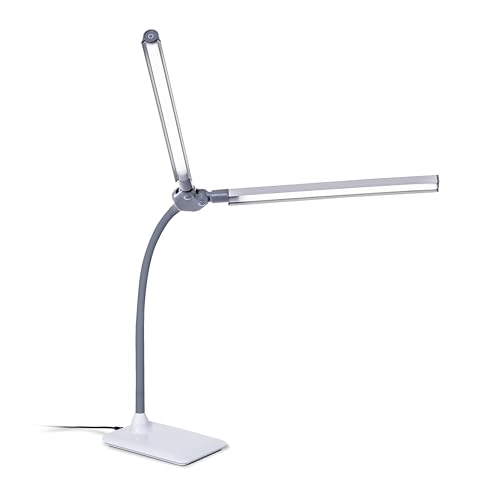 Daylight DuoPro Daylight DuoPro | $81.99 | 6,000K | 95+ | 2,100 lux | Twin-shade table lamp | Price |
 Daylight Wafer 2 Daylight Wafer 2 | $81.99 | Not listed | Not listed | 320 lumens | A3 light box | Price |
 OttLite ClearSun Floor OttLite ClearSun Floor | $139.99 | Not listed | 95+ | 3 levels | Floor lamp, 47.5 to 64 in | Price |
 Daylight Lumi Daylight Lumi | $199.99 | Not listed | 95+ | 4,000 lux | Long-reach desk lamp | Price |
 Daylight Slimline 4 Daylight Slimline 4 | $223.99 | 6,000K | 95+ | 3,200 lux at 30 cm | Clamp table lamp | Price |
 Daylight Slimline 4 Floor Daylight Slimline 4 Floor | $224.99 | 6,000K | 95+ | 3,200 lux at 30 cm | Floor lamp | Price |
 Daylight Anita Daylight Anita | $243.08 | 6,000K plus cool and warm modes | 95+ | Up to 2,600 lux | Floor lamp with magnifier | Price |
 Daylight Artist Studio 2 Daylight Artist Studio 2 | $274.99 | 6,000K | 95+ | 6,000 lux | Studio floor lamp | Price |
Beginner
Beginner picks: true daylight color for under $150
You do not need to spend $200 to get accurate color. These cost less because they are smaller or publish fewer figures, not because the light is poor.
Daylight Company DuoPro Double Shade Table Lamp
$81.99The least expensive lamp here that publishes both 6,000K and 95+ CRI. Its two shades hold 56 LEDs for 2,100 lux, with four touch brightness levels, so it covers a cross stitch chart and the fabric beside it.
Best for: Floss matching at a table
Check price OttLite ClearSun LED Floor Lamp
$139.99OttLite lists 95+ CRI for its ClearSun LEDs and the lamp adjusts from 47.5 to 64 inches with three touch brightness levels. OttLite does not publish a Kelvin figure for this model, so it is a color-accuracy pick rather than a verified 6,000K pick.
Best for: A reading chair on a budget
Check price Daylight Company Wafer 2 A3 Light Box
$81.99Not a lamp, but daylight from below: an 8 mm thin A3 light pad with an 18 by 13 inch work area, 320 lumens and a dimmer with memory. It is the tool for tracing embroidery designs or checking fabric overlap in applique.
Best for: Tracing patterns onto fabric
Check pricePrices change often, so confirm on Amazon. As an Amazon Associate we earn from qualifying purchases.
Intermediate
Intermediate picks: brighter daylight from $200 to $225
This tier adds brightness and published measurement distances, which makes it easier to know what you are buying.
Daylight Company Slimline 4 LED Floor Lamp
$224.996,000K, 95+ CRI and 3,200 lux at 30 cm across four brightness levels, plus a USB-C charging port. A floor lamp can serve every craft station in a room, which makes it better value than several table lamps.
Best for: Whole craft room color checks
Check price Daylight Company Slimline 4 LED Table Lamp
$223.99The same 6,000K, 95+ CRI and 3,200 lux at 30 cm light in a table version that clamps or screws to a desk edge. Choose it when floor space is tight or you work at one table.
Best for: A dedicated craft desk
Check price Daylight Company Lumi Task Lamp
$199.99A 100 cm reach and 4,000 lux at 95+ CRI on 15W, with two brightness levels. Daylight does not list a Kelvin figure for it, but the long arm covers a wider table than the Slimline.
Best for: Large tables and quilt blocks
Check pricePrices change often, so confirm on Amazon. As an Amazon Associate we earn from qualifying purchases.
Expert
Expert picks: studio brightness and adjustable color from $240
These are for large pieces, color-critical work and people who want to see how a project looks under warm home light too. Who should NOT buy this tier: if you stitch small pieces at one table, 6,000 lux is more than you need, and an Intermediate lamp gives the same color accuracy for less.
Daylight Company Artist Studio Lamp 2
$274.99The brightest lamp here at 6,000 lux, with 6,000K, 95+ CRI light, a 24 cm shade and a continuous dimmer. It is built to light a large frame, a quilt top or a design wall.
Best for: Large frames and design walls
Check price Daylight Company Anita Floor Lamp with Magnifier
$243.08Up to 2,600 lux at 95+ CRI with a 6,000K daylight mode plus cool and warm modes, and it comes with a magnifier, phone clamp and clip-on tray. The warm mode lets you preview a gift under the kind of light it will live in.
Best for: Stitchers who want magnification and color modes
Check pricePrices change often, so confirm on Amazon. As an Amazon Associate we earn from qualifying purchases.
What does color temperature mean on a lamp?
Color temperature describes whether white light looks warm (yellowish) or cool (bluish). It is measured in Kelvin. Lower numbers are warmer, higher numbers are cooler. A typical living room bulb is warm; midday daylight is much cooler. Lighting standards organizations use a reference called D65 to represent average daylight, and it sits around 6,500K, which is why craft lamps aimed at daylight cluster between 5,000K and 6,500K.
| Color temperature | How it looks | Common source | For crafts |
|---|---|---|---|
| 2,700K | Warm, golden white | Household "soft white" bulbs | Cozy, but blues look dull and whites look cream |
| 3,000K | Warm white | Many kitchen and bath fixtures | Still shifts colors toward yellow |
| 4,000K | Neutral white | Offices, garages, shop lights | Acceptable for general sewing, less ideal for color matching |
| 5,000K | Clean daylight white | Bulbs sold as daylight | Good for color work |
| 6,000K to 6,500K | Cool daylight | Daylight craft lamps, D65 daylight reference | Best for matching floss, yarn and fabric |
Color temperature alone does not make a lamp accurate. A cheap 6,500K bulb can still distort colors badly, which is where CRI comes in.
What does CRI mean on a craft lamp?
CRI stands for Color Rendering Index. It is a score up to 100 that describes how faithfully a light source shows colors compared with a reference light. Higher is better. Many ordinary LED bulbs are rated around 80, which looks fine for reading but can flatten reds and make similar shades hard to tell apart.
Every lamp in our list is rated 95+ CRI where the maker publishes it. For a crafter, that means the difference between DMC 3346 and DMC 3347 greens, or two navy batiks, is visible under the lamp instead of only by a window. CRI is an average across a set of test colors, so two 95+ lamps can still differ slightly on deep reds, but 95+ is the class you want.
Kelvin vs CRI in one sentence
Kelvin tells you the color of the light; CRI tells you how honestly that light shows the colors of your materials. You want both: roughly 5,000K to 6,500K and 95+ CRI.
Why do my floss colors look different at night?
Two threads can match under one light and not under another. Color scientists call this metamerism. Warm household bulbs are weak in blue and strong in yellow and red, so under them a cool gray and a warm gray can look identical, then clash the next morning.
The practical fix is to make every color decision under the same high-CRI daylight lamp: pulling floss for a chart, choosing a binding, or picking yarn for stripes. If a piece will hang in a warm-lit room, a lamp with a warm mode like the Daylight Anita lets you check how it will look there too. Use the cross stitch floss calculator to plan quantities once your colors are chosen.
Is a daylight lamp better than warm light for crafts?
For work where color matters, yes. For relaxing in the evening, warm light is more comfortable for many people, and some find very cool light harsh for long sessions. That is why dimmable daylight lamps are so popular: turn the lamp up for color decisions and detail, then down once you are stitching a large block of one color.
Brightness, measured in lux at the work surface, is a separate question from color. A 6,000K lamp that is too dim still makes you squint. For placement and brightness by task, see our lighting guide for sewing and crafts.
Is Daylight or OttLite better for crafts?
Both brands sell lamps rated 95+ CRI. Daylight tends to publish more numbers, including Kelvin and lux at a stated distance, which is why most lamps in our compare table are Daylight models. OttLite usually costs less; the OttLite ClearSun Floor is a 95+ CRI floor lamp for about $140. If published figures matter to you, Daylight is easier to compare. If price matters more, OttLite is a strong choice. Read OttLite vs Daylight for the full comparison, or the OttLite ClearSun floor lamp review and Daylight Slimline 4 review.
How we chose
We did not test these lamps in person. We selected lamps whose makers publish color rendering of 95+ CRI, then compared published color temperature, lux and measuring distance, reach and controls from manufacturer specifications and listings. We also read recurring themes in verified owner reviews about color accuracy, glare and build. Where a maker does not publish a figure, we say "Not listed" rather than guess.
Buying tips
- Look for both numbers: about 5,000K to 6,500K and 95+ CRI.
- Treat "daylight" on a box as marketing unless Kelvin and CRI are published.
- Choose a dimmable lamp so cool light is not harsh during long sessions.
- Compare lux only at the same measuring distance.
- Make all color choices for one project under the same lamp.
- If colors still look washed out or hard to tell apart under good light, see an eye doctor.
Frequently asked questions
What is the best color temperature for crafts?
For color matching, aim for roughly 5,000K to 6,500K, which is close to midday daylight. Daylight craft lamps such as the Daylight Slimline 4 and DuoPro are rated 6,000K. Warmer light around 2,700K is comfortable for relaxing but tints whites cream and dulls blues, which makes choosing floss, yarn or fabric harder.
What CRI should a craft lamp have?
Look for 95 or higher. CRI, the Color Rendering Index, scores how faithfully a light shows colors against a reference, with 100 as the top. Many everyday LED bulbs are around 80, which can make similar shades look the same. Every lamp on our list that publishes a CRI figure is rated 95+, including the OttLite ClearSun and Daylight models.
Is 6500K too bright for crafting?
Kelvin describes color, not brightness. A 6,500K lamp looks cool white, and some people find it harsh over long sessions. Brightness is measured in lux or lumens. Choose a dimmable daylight lamp so you can keep the cool, accurate color while turning the output down, and add some warm room light so the contrast between lamp and room is not extreme.
Do daylight lamps help you see better?
A bright, high-CRI lamp makes detail and color easier to see than dim or yellow light, which is why many stitchers find them helpful. A lamp does not change your eyesight, though. If you have trouble seeing fine work even under good light, or you notice new blurriness or discomfort, see an eye doctor rather than relying on a brighter lamp.
Why does my thread look different in daylight?
Different light sources emphasize different parts of the color spectrum, so two colors can match under one light and differ under another. This is called metamerism. Warm bulbs push colors toward yellow and hide differences between cool shades. Choosing colors under a 95+ CRI daylight lamp reduces surprises, and a lamp with a warm mode lets you preview a piece in home lighting.
Is a light box a daylight lamp?
Not exactly. A light box like the Daylight Wafer 2 is an LED panel you work on top of, used to trace embroidery designs or quilting motifs through fabric. It has an 18 by 13 inch work area, 320 lumens and a dimmer. It complements a daylight task lamp rather than replacing it, because it lights from below instead of onto the front of your work.
How we research: we compare manufacturer specifications, owner manuals, published standards and recurring themes in verified owner reviews. We do not test products in person, and this is researched guidance, not professional advice. Follow your machine manual and pattern, and take care with rotary cutters, hot irons and needles. As an Amazon Associate we earn from qualifying purchases.