Quilt Fabric Yardage Calculator: Yardage for Squares, Rectangles and Strips by Fabric
Count how many pieces fit across the usable fabric width, divide the pieces you need by that number to get strips, and multiply strips by the strip width. Eighty 5 inch squares fit 8 per strip on 40 inch usable cotton, so they need 10 strips, or 1 1/2 yards. Always round up to the next 1/8 yard.
Enter the cut size and number of pieces for each fabric in your quilt top, up to four fabrics. The calculator finds how many pieces fit across each strip, tries every rectangle both ways, and gives yards per fabric plus the total, rounded up to the 1/8 yard a shop can cut.
Your pieces (cut sizes)
Your results
Total fabric to buy
160 pieces from 3 fabrics
| Fabric | Strips | Yards |
|---|---|---|
| Fabric 1 | 10 x 5 in (8 per strip) | 1 1/2 yd |
| Fabric 2 | 4 x 4 1/2 in (16 per strip) | 1/2 yd |
| Fabric 3 | 7 x 6 1/2 in (3 per strip) | 1 3/8 yd |
| Fabric 4 | None | 0 |
Add 1/8 to 1/4 yard per fabric for straightening and mistakes.
Tools that speed up a full quilt top of cutting
Three to eight yards is a lot of repeat cuts. A rotating mat, a big square ruler and a manual die cutter take hours off the cutting stage.

Olfa 17 x 17 Rotating Cutting Mat RM-17S
$100.98Turn the mat instead of the fabric when trimming squares and blocks.
Check price
Creative Grids 12-1/2 x 24-1/2 Rectangle Quilt Ruler
$55.99A 12 1/2 x 24 1/2 in ruler handles strips and subcuts without swapping rulers.
Check price
AccuQuilt GO! Fabric Cutter Starter Set
$329.99A folding die cutter that cuts up to six layers of cotton in one pass.
Check pricePrices change often, so confirm on Amazon. As an Amazon Associate we earn from qualifying purchases.
Rotary cutting basics for a small project
Under three yards of cutting, a sharp cutter, a long ruler and a good mat are all you need.
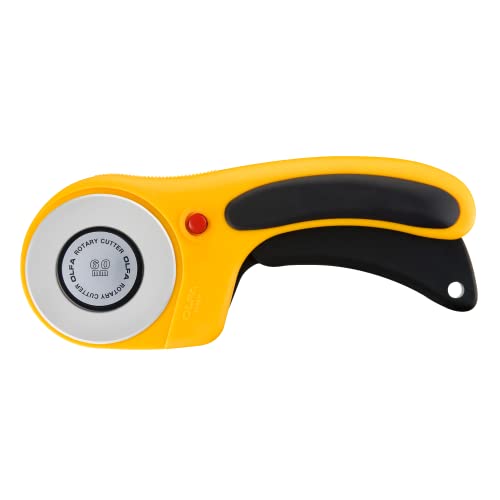
Olfa 60mm Ergonomic Squeeze-Handle Rotary Cutter RTY-3/DX
$26.49A 60 mm blade cuts up to 12 layers of cotton, so stacked strips go quickly.
Check price
Creative Grids Quilt Ruler 6-1/2 x 24-1/2 in Rectangle CGR24
$39.99A non-slip 6 1/2 x 24 1/2 in ruler for cutting strips across the full width of fabric.
Check price
Olfa 24 x 36 Self-Healing Rotary Mat RM-MG
$59.99A 24 x 36 in double-sided mat, big enough for folded width-of-fabric cuts.
Check pricePrices change often, so confirm on Amazon. As an Amazon Associate we earn from qualifying purchases.
Cutting eight yards or more: go electric
At this volume, an electric die cutter and a long mat on a real cutting table save your wrists and your weekend.

AccuQuilt GO! Big Electric Fabric Cutter Starter Set
$699.99One-button electric die cutter for up to six layers, compatible with all GO! dies including GO! Big dies.
Check price
Olfa 35 x 70 Continuous Grid Connecting Rotary Mat Set
$209.99Three connecting mats that make a 35 x 70 in surface for long cuts.
Check price
Arrow Millie Folding Cutting Table with Ironing Board
$699.99A dedicated cutting table so long cutting sessions happen at a comfortable height.
Check pricePrices change often, so confirm on Amazon. As an Amazon Associate we earn from qualifying purchases.
How do you calculate fabric yardage for a quilt top?
Quilt fabric is cut in strips across the width of fabric, often shortened to WOF, and then the strips are cut into pieces. So yardage is really a question of how many strips you need and how wide each strip is. Every piece is entered at its cut size, which already includes the 1/4 inch seam allowance on each side.
- Pieces per strip. Divide the usable width by the piece's cut width and round down. Five inch squares on 40 inch usable cotton: 40 / 5 = 8 per strip.
- Strips needed. Divide the pieces by pieces per strip and round up. Eighty squares / 8 = 10 strips.
- Inches of fabric. Multiply strips by the strip width, which is the other dimension of the piece: 10 x 5 = 50 inches.
- Convert to yards and round up to 1/8 yard. 50 / 36 = 1.39 yards, which rounds up to 1 1/2 yards.
Rectangles get one more step: try them both ways. Twenty 6 1/2 x 12 1/2 inch rectangles with the long side across the strip fit 3 per strip, need 7 strips 6 1/2 inches wide, and use 45.5 inches, or 1 3/8 yards. Turned the other way they fit 6 per strip, need 4 strips 12 1/2 inches wide, and use 50 inches, or 1 1/2 yards. The calculator picks the smaller figure automatically and shows the strip width to cut.
For the default example, the three fabrics need 1 1/2, 1/2 and 1 3/8 yards, a total of 3 3/8 yards. The total is the sum of each fabric rounded separately, because the shop cuts each fabric on its own.
How many squares can you cut from a yard of fabric?
This chart uses the same math with 40 inches of usable width. "Per yard" counts only whole strips that fit in 36 inches, so a partial strip left over at the end is not counted.
| Cut square | Per WOF strip | Per yard | Yards for 50 | Yards for 100 |
|---|---|---|---|---|
| 2 1/2 in | 16 | 224 | 3/8 yd | 1/2 yd |
| 3 1/2 in | 11 | 110 | 1/2 yd | 1 yd |
| 4 1/2 in | 8 | 64 | 7/8 yd | 1 5/8 yd |
| 5 in | 8 | 56 | 1 yd | 1 7/8 yd |
| 6 1/2 in | 6 | 30 | 1 5/8 yd | 3 1/8 yd |
| 8 1/2 in | 4 | 16 | 3 1/8 yd | 6 yd |
| 10 1/2 in | 3 | 9 | 5 yd | 10 yd |
| 12 1/2 in | 3 | 6 | 6 yd | 11 7/8 yd |
Notice the jumps. A 4 1/2 inch square fits 8 across a strip, but a 5 inch square also fits 8, so the extra half inch costs nothing across the width, only in strip height. A 6 1/2 inch square fits 6. If a pattern's piece sits just over a threshold, trimming a planned size down by 1/8 inch is sometimes the difference of a whole strip.
How much fabric do width-of-fabric strips take?
Many quilts are strip pieced, and binding, sashing and borders all start as WOF strips. Yardage for strips is the simplest math of all: strips times width, divided by 36.
| Strip width | Strips per yard | 10 strips | 20 strips |
|---|---|---|---|
| 1 1/2 in | 24 | 1/2 yd | 7/8 yd |
| 2 in | 18 | 5/8 yd | 1 1/8 yd |
| 2 1/2 in | 14 | 3/4 yd | 1 1/2 yd |
| 3 1/2 in | 10 | 1 yd | 2 yd |
| 4 1/2 in | 8 | 1 1/4 yd | 2 1/2 yd |
| 5 in | 7 | 1 1/2 yd | 2 7/8 yd |
| 6 1/2 in | 5 | 1 7/8 yd | 3 5/8 yd |
Straighten before you count
Fold the fabric selvage to selvage, square the folded edge to your mat, and trim a thin sliver before cutting the first strip. A crooked first cut makes V-shaped strips and wastes more fabric than the sliver.
Does fabric width change how much yardage you need?
It can change it a lot, because more width means more pieces per strip. The default example needs 3 3/8 yards with 40 inches of usable width, 3 3/8 yards with 42 inches, and 2 1/2 yards with 58 inches, which is typical of 60 inch wide apparel fabric. Enter your fabric's real usable width in the calculator. Our fabric width chart lists common bolt widths, and the fabric yardage chart converts yard fractions to inches.
Wider is not always better for quilting. Wide apparel fabrics can have a different weight and stretch than quilting cotton, which makes blocks harder to keep square. Wide quilt backing is a better use of extra width, and the quilt backing calculator handles 108 inch fabric.
When does it make sense to use a die cutter instead of a rotary cutter?
For a few yards of cutting, a rotary cutter, ruler and mat are fast and precise. Once a quilt needs hundreds of identical pieces, the math changes. A die cutter cuts up to six layers at once and every shape comes out the same, including half square triangles with the dog ears already trimmed. The results panel switches its suggestions with your total: rotary basics under 3 yards, faster hand tools and a manual die cutter from 3 to 8 yards, and an electric die cutter and big mats above 8 yards.
Comfort is the other reason. Hours of pressing down on a rotary cutter are hard on wrists and shoulders, and a cutting table at the right height helps as much as the cutter does. If you are comparing systems, see the AccuQuilt vs Cricut Maker comparison and the best fabric cutting machines for quilting.
Frequently asked questions
How do you calculate fabric yardage for quilt pieces?
Divide the usable fabric width by the cut width of one piece and round down to get pieces per strip. Divide the pieces needed by pieces per strip and round up to get strips. Multiply strips by the cut height, divide by 36, and round up to the next 1/8 yard. Twenty 6 1/2 x 12 1/2 inch rectangles need 1 3/8 yards when turned the efficient way.
What usable width should I use for quilting cotton?
Quilting cotton is sold 42 to 45 inches wide, but selvages take 1 to 2 inches, and prewashing shrinks it a little more. Most patterns plan on 40 to 42 inches usable. This calculator defaults to 40 inches, the safer choice. Measure your own fabric after washing and trimming selvages if you want a tighter estimate.
Does it matter which way I cut rectangles?
Yes. Turning a rectangle so its long side runs across the strip can use less fabric. Twenty 6 1/2 x 12 1/2 inch rectangles cut 12 1/2 inches across a 40 inch strip need 7 strips 6 1/2 inches wide, or 1 3/8 yards. Cut 6 1/2 inches across, they need 4 strips 12 1/2 inches wide, or 1 1/2 yards. The calculator checks both and uses the smaller.
Should I buy extra fabric beyond the calculated yardage?
Most quilters add 1/8 to 1/4 yard per fabric. Shops cut slightly crooked, the first cut straightens the edge, and a miscut piece has to come from somewhere. For directional prints or fussy cutting, add more, since pieces cannot be rotated to fit. For a fabric you might not find again, buying an extra half yard is cheap insurance.
Is it cheaper to buy fat quarters or yardage?
A fat quarter is about 18 x 21 inches, while a quarter yard cut from the bolt is 9 x 42 inches. They hold the same area, but a fat quarter fits bigger squares. For pieces over 9 inches, fat quarters work where a regular quarter yard cannot. For long strips, yardage is better. The precut fabric calculator compares fat quarters, charm packs and layer cakes.
How we research: we compare manufacturer specifications, owner manuals, published standards and recurring themes in verified owner reviews. We do not test products in person, and this is researched guidance, not professional advice. Follow your machine manual and pattern, and take care with rotary cutters, hot irons and needles. As an Amazon Associate we earn from qualifying purchases.