Best Magnifier for Cross Stitch (2026): 11 Lamps, Visors and Floor Magnifiers
The best magnifier for most cross stitchers is the Brightech LightView Pro floor lamp, about $115, because its wide 6.5 by 4 inch glass lens lets you use both eyes over an 18 count chart. Stitchers on 28 count linen should step up to the Daylight Magnificent Pro, which pairs 1.75X glass with CRI 95+ daylight LEDs.
For most stitchers the best magnifier for cross stitch is the Brightech LightView Pro floor magnifier, at about $115. It has a wide rectangular glass lens and a 24 inch gooseneck that reaches over a chair. You can look through it with both eyes, and you can still see the chart beside your hoop.
The right magnifier depends on your fabric count, on where you sit, and on whether you also need better light. Usually you do. Below you'll find picks for three budgets, a chart matching magnification to fabric count, and a plain explanation of diopters so the numbers on the box make sense.
The magnifiers at a glance
| Product | Price | Type | Magnification | Light quality | Buy |
|---|---|---|---|---|---|
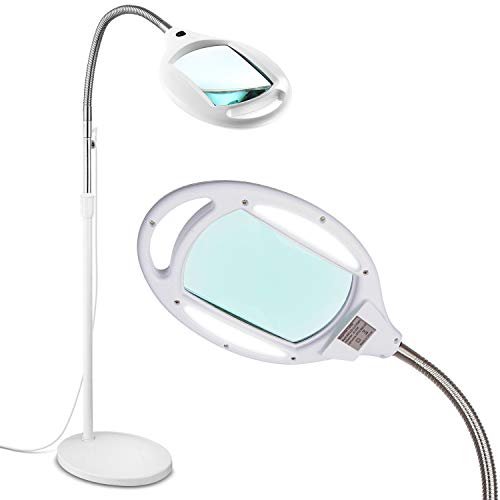 Brightech LightView Pro Floor Brightech LightView Pro Floor | $114.99 | Floor lamp | 6.5 x 4 in glass lens | Not published | Price |
 OttLite Hands-Free Magnifier OttLite Hands-Free Magnifier | $23.99 | Neck-worn | 4.33 in lens | Battery LED | Price |
 OttLite Prevention Magnifier OttLite Prevention Magnifier | $71.99 | Desk lamp | 1.7x, 3.4x spot | CRI 95+ | Price |
 Brightech LightView Pro Desk Brightech LightView Pro Desk | $84.99 | Clamp lamp | 2.25x glass | Not published | Price |
 OttLite 2-in-1 Magnifier OttLite 2-in-1 Magnifier | $119.99 | Floor or table | 2X, 4X spot | CRI 95+, 240 lumens | Price |
 Carson MagniVisor Deluxe Carson MagniVisor Deluxe | $37.99 | Head visor | 1.5x to 3x lenses | Removable LED | Price |
 Daylight Halo Go 2 Daylight Halo Go 2 | $104.49 | Portable lamp | 2.25X, 4X inset | 6,000K, CRI 95+ | Price |
 Neatfi Elite XL HD Neatfi Elite XL HD | $149.95 | Clamp lamp | 2.25x, 7 in glass | 6500K | Price |
 OttLite EasyView OttLite EasyView | $159.99 | Floor lamp | 1.75x, 3x spot | CRI 95+ | Price |
 Daylight Magnificent Pro Daylight Magnificent Pro | $197.99 | Floor lamp | 1.75X, 5 in lens | 6,000K, CRI 95+ | Price |
 Daylight Anita Daylight Anita | $243.08 | Floor lamp | Magnifier included | 6,000K, CRI 95+ | Price |
Beginner
Beginner picks: real magnification for under $125
These cover 14 to 18 count Aida, which is where most kits live. Anything under about $125 should still have a glass or optical grade lens. Cheap acrylic lenses scratch, and those scratches blur the grid.
Brightech LightView Pro LED Magnifying Floor Lamp
$114.99The rectangular 6.5 by 4 inch diopter glass lens is the widest in this tier, so you can view with both eyes without leaning in. The 24 inch gooseneck brings it over a lap frame or seat stand.
Best for: Chair and sofa stitchers
Check price OttLite 2-in-1 ClearSun LED Magnifier Floor and Table Lamp
$119.99It converts between floor and table use, so one purchase covers the recliner and the dining table. The 5 inch 2X lens has a 4X spot viewer for fractional stitches, and the light is CRI 95+.
Best for: Stitching in two places
Check price OttLite Prevention LED Desk Lamp with Magnifier
$71.99At about $72 it is the cheapest lamp here with CRI 95+ light and a 3.4x spot viewer. It adjusts from 10 to 21 inches tall, a good size for a table or craft desk.
Best for: Table stitching on a budget
Check price OttLite 4-Inch Hands-Free LED Magnifier
$23.99A neck-cord magnifier with a 4.33 inch lens and built-in battery light, for about $24. It travels to guild meetings and waiting rooms where a lamp cannot.
Best for: Stitching away from home
Check pricePrices change often, so confirm on Amazon. As an Amazon Associate we earn from qualifying purchases.
Intermediate
Intermediate picks: brighter daylight LEDs and wider glass, $100 to $200
This is the tier for 25 to 28 count evenweave and linen, for stitching dark fabric at night, and for anyone whose eyes tire after an hour. Here you pay for daylight-balanced light (6,000K, CRI 95+) and for lenses that stay sharp to the edge.
Daylight Company Magnificent Pro Magnifying Lamp
$197.99It has a 5 inch 1.75X lens and 600 lumens of 6,000K, CRI 95+ light, with steps of 5,500, 3,500 and 1,500 lux. Lower magnification over a wider lens is easier on the neck for long sessions than a strong small lens.
Best for: 28 count linen, long sessions
Check price OttLite EasyView LED Floor Lamp with Magnifier
$159.99A floor magnifier that adjusts from 48 to 64 inches, with a 1.75x lens, a 3x spot viewer and CRI 95+ light in three brightness levels. It is a solid middle step between the Brightech and the Daylight.
Best for: Tall chairs and wingbacks
Check price Neatfi Elite XL HD Magnifying Lamp with Clamp
$149.95The 7 inch glass lens is the largest listed here, at 5 diopter (2.25x) with 6500K light and a 3 year warranty. It clamps to a table, so it works well for stitchers who work at a desk.
Best for: Big lens at a desk
Check price Daylight Company Halo Go 2 Rechargeable Magnifying Lamp
$104.49A rechargeable lamp that runs up to 8 hours, with a 5 diopter (2.25X) lens, a 12 diopter (4X) inset, and 4,200 lux at 15 cm. Carry it from room to room or to a retreat.
Best for: Cordless, room to room
Check price Carson Pro Series MagniVisor Deluxe Head-Worn Magnifier
$37.99A head-worn visor with four lenses from 1.5x to 3x and a removable LED. It is the answer when a lamp head always seems to be in the wrong place.
Best for: Large scroll frames
Check pricePrices change often, so confirm on Amazon. As an Amazon Associate we earn from qualifying purchases.
Expert
Expert pick: a full daylight floor lamp with magnifier, about $240
You don't need this tier if you stitch 14 count Aida by a sunny window, or if you already own a good daylight floor lamp and only want a lens. Add a visor in that case. It suits stitchers working 32 count and up, dark or hand-dyed fabrics, and long evening sessions.
Daylight Company Anita Floor Lamp with Magnifier
$243.08It reaches up to 2,600 lux of 6,000K, CRI 95+ light, with cool and warm modes for matching floss under the light it will be displayed in. The magnifier, phone clamp and clip-on tray are included.
Best for: High-count linen and night stitching
Check pricePrices change often, so confirm on Amazon. As an Amazon Associate we earn from qualifying purchases.
What is the best magnification for cross stitch?
Match magnification to your fabric count, not to how strong a lens looks. Stronger lenses magnify more, but they shrink the area in focus and the distance you can hold the work from the glass. Too much magnification makes you chase the needle. Many stitchers who start with a 4X lens end up using 1.75X to 2.25X for most of the piece and a small spot lens for fractional stitches.
If you are not sure what count you have, the cross stitch fabric count chart shows stitches per inch for each fabric. The cross stitch fabric calculator shows how a design size changes when you move to a finer count.
| Fabric | Stitches per inch | Typical magnification | Good fit from this list |
|---|---|---|---|
| 11 to 14 count Aida | 11 to 14 | None to 1.75x | OttLite Prevention Magnifier |
| 16 count Aida | 16 | 1.75x to 2x | OttLite EasyView |
| 18 count Aida | 18 | 2x to 2.25x | Brightech LightView Pro Floor |
| 25 to 28 count evenweave over two | 12.5 to 14 | 1.75x to 2.25x, plus better light | Daylight Magnificent Pro |
| 28 count linen over one | 28 | 2.25x with a 3x to 4x spot lens | Daylight Halo Go 2 |
| 32 to 40 count linen | 16 to 20 over two | 2.25x plus high lux daylight | Daylight Anita |
What does diopter mean on a magnifier?
Diopter is a measure of how strongly a lens bends light. Magnifier makers usually convert it with a simple rule: divide the diopter by 4 and add 1. That is why a 5 diopter lens is sold as 2.25X and a 12 diopter inset as 4X, as on the Daylight Halo Go 2.
The same number tells you roughly how far the lens should sit from the fabric. In centimeters, that distance is about 100 divided by the diopter. A 3 diopter (1.75X) lens focuses around 33 cm, or 13 inches, from the work, leaving plenty of room for your hands and needle. A 5 diopter lens focuses closer, around 20 cm or 8 inches. This is why low-power, wide lenses feel more relaxed over a hoop.
Eyes first
A magnifier makes stitching comfortable, but it is not a substitute for an eye exam. If you are suddenly squinting at a count you used to manage, see an eye doctor before buying stronger glass.
What is the best magnifying floor lamp for cross stitch?
A floor lamp suits most cross stitchers because it keeps the table and lap clear for a hoop, a scroll frame or a floor stand. Look for three things: a lens wide enough for both eyes, an arm that reaches past the edge of your chair, and daylight LEDs rated CRI 95 or higher so floss colors read true.
The Brightech LightView Pro Floor wins on lens size for the money. The Daylight Magnificent Pro wins on light quality, with 6,000K LEDs and three lux settings. The OttLite EasyView sits between them on price and adjusts from 48 to 64 inches tall. If you are torn between a lamp and a visor, our magnifier lamp vs magnifying visor comparison goes through the tradeoffs, and the Brightech LightView Pro review covers what owners report about it.
Are hands-free magnifiers good for cross stitch?
Yes. Both neck-worn and head-worn magnifiers work, but they fit different habits. The OttLite Hands-Free Magnifier rests on your chest on an adjustable cord, so you look down through it at a hoop held at lap height. It suits small projects and travel, though anything on a cord can swing when you lean forward.
The Carson MagniVisor Deluxe sits on your head like a visor, so the lens goes wherever you look. That makes it useful for large scroll frames, where a lamp would need constant repositioning. Its four swappable lenses run from 1.5x to 3x. If you wear reading glasses under a visor, remember that the two magnifications add together and shorten your focus distance.
Does an OttLite with a magnifying glass work for cross stitch?
OttLite's magnifier lamps pair a main lens with a smaller spot viewer, which suits cross stitch well. You work the full stitches through the main lens and use the spot viewer for quarter stitches, backstitch and French knots. The OttLite Prevention Magnifier uses a 1.7x main lens with a 3.4x spot. The OttLite 2-in-1 Magnifier uses 2X with a 4X spot and converts from floor to table.
All three OttLite magnifier lamps listed here are rated CRI 95+. If you are deciding between brands for a plain lamp, see OttLite vs Daylight. For lighting a whole stitching corner, read our guide to lighting for sewing and crafts.
How we chose
We did not test these magnifiers in person. We compared manufacturer specifications (lens size, diopter or stated magnification, color temperature, CRI, lux and height range), warranty terms and the recurring themes in verified owner reviews from cross stitchers and needlepointers. We favored glass or optical grade lenses, published CRI ratings of 95 or higher, and arms long enough to reach over a chair or stand. Magnifiers with plastic lenses or no published light specs were left out.
Buying tips
- Buy for your finest regular fabric, not your worst day. A 1.75X to 2.25X main lens covers most counts; add a spot lens for detail.
- Wider beats stronger. A lens that fits both eyes reduces neck and eye fatigue over long sessions.
- Check the reach. Measure from where the lamp base will sit to the center of your hoop; many arms fall short of a recliner.
- Look for CRI 95+. Neighboring floss shades like DMC 3865 and blanc are hard to tell apart under low-CRI light.
- Keep the lens clean. Wipe glass with a microfiber cloth; paper towels scratch coatings.
- Plan your working distance. Stronger lenses sit closer to the work and leave less room for your needle hand.
Frequently asked questions
What magnification do I need for 18 count Aida?
Most stitchers find 2x to 2.25x comfortable on 18 count Aida. That is the range of a 5 diopter lens such as the Brightech LightView Pro desk lamp or the Neatfi Elite XL. Stronger lenses shrink the focus area and force you closer to the fabric, which makes stitching slower. If fractional stitches are the only struggle, a lamp with a small 3x to 4x spot viewer is a better answer than a stronger main lens.
Is a magnifying lamp or a visor better for cross stitch?
A lamp is better if you stitch in one spot, because it adds light and needs nothing on your head. A visor is better if you work large scroll frames or move around, because the lens follows your eyes. Many stitchers own both: a floor magnifier at home and a visor or neck magnifier for classes and travel. Our lamp versus visor comparison page walks through the details.
Can magnifying glasses for cross stitch hurt my eyes?
Using a magnifier is not known to damage eyes, but a lens that is too strong or set at the wrong distance can cause eye strain and headaches. Start with lower magnification, keep the work at the focal distance of the lens, and take breaks. If you notice a sudden change in how well you see your fabric, see an eye doctor rather than buying stronger glass.
What is the best magnifying light for cross stitch on dark fabric?
Dark Aida and black linen need more light, not only more magnification. Look for daylight LEDs around 6,000K with CRI 95+ and a high lux rating, such as the Daylight Magnificent Pro with settings up to 5,500 lux or the Daylight Anita at up to 2,600 lux. Many stitchers also put a white cloth or light pad on their lap under dark fabric so the holes show.
How far should a magnifier be from my cross stitch?
Roughly 100 centimeters divided by the lens diopter. A 3 diopter lens, sold as about 1.75X, focuses best around 33 cm or 13 inches from the fabric. A 5 diopter lens (2.25X) focuses around 20 cm or 8 inches away. Move the lens until the grid is crisp from edge to edge, then leave enough room beneath it for your needle hand to pass comfortably.
Do I need a floor stand to use a magnifier?
Not always, but a stand helps. When you hold a hoop in one hand, it drifts in and out of the lens focus, and you have to keep refocusing. A floor or seat stand keeps the fabric at a fixed distance, frees both hands for the stab method, and makes a magnifier far more comfortable over a long session.
How we research: we compare manufacturer specifications, owner manuals, published standards and recurring themes in verified owner reviews. We do not test products in person, and this is researched guidance, not professional advice. Follow your machine manual and pattern, and take care with rotary cutters, hot irons and needles. As an Amazon Associate we earn from qualifying purchases.