Thread Weight Chart: 12 wt to 100 wt Uses and Needle Sizes
Thread weight runs backward: a higher number is a finer thread. 12 and 28 wt are heavy decorative threads, 40 wt is standard for machine embroidery and bold quilting, 50 wt is the everyday piecing and garment thread, and 60 to 100 wt are fine threads for bobbins and invisible quilting. Pair heavier thread with a larger needle.
Thread weight (wt) is an inverse measure: the higher the number, the finer the thread.
What are the thread weights and what are they used for?
| Weight | Thickness | Uses | Needle | Examples |
|---|---|---|---|---|
| 12 wt | Very heavy | Big-stitch hand quilting, Bold machine quilting, Decorative topstitching, Hand embroidery accents | 90/14 or 100/16 Topstitch (Aurifil 12 wt) | Aurifil 12 wt cotton, WonderFil Spagetti 12 wt, Sulky 12 wt Cotton |
| 28 wt | Heavy | Machine quilting with visible texture, Hand quilting, Blanket stitch applique, Hand applique and embroidery | 90/14 Topstitch, Quilting, or Denim (Aurifil 28 wt) | Aurifil 28 wt cotton |
| 30 wt | Medium heavy | Decorative stitching, Quilting that should show, Some embroidery | 90/14 is a common starting point | Sulky 30 wt Cotton |
| 40 wt | Medium | Machine quilting with stitch definition, Machine embroidery (standard weight), Topstitching, Piecing | 80/12 Microtex, Sharp, Universal, or Denim (Aurifil 40 wt); 90/14 Topstitch (Superior King Tut and Fantastico) | Aurifil 40 wt, Superior King Tut 40 wt, Superior Fantastico 40 wt, Isacord 40 (polyester embroidery) |
| 50 wt | Fine | Piecing with flat seams, Garment sewing, Machine applique, Subtle quilting, Bobbin thread | 80/12 Microtex, Sharp, Universal, or Denim (Aurifil 50 wt); 90/14 Topstitch (Superior So Fine! 50) | Aurifil Mako 50 wt, Superior So Fine! 50, WonderFil Konfetti 50 wt |
| 60 wt | Fine | Bobbin thread for embroidery and quilting, Fine piecing, Heirloom sewing, Applique | 90/14 Topstitch (Superior Bottom Line); 70/10 to 80/12 also used | Superior Bottom Line 60 wt |
| 80 wt | Very fine | Invisible machine and hand applique, Heirloom sewing, Fine detail quilting, English paper piecing | 70/10 or 80/12 Microtex, Sharp, or Embroidery (Aurifil 80 wt) | Aurifil 80 wt |
| 100 wt | Ultra fine | Micro-stippling and dense background quilting, Invisible applique, Heirloom machine quilting | 70/10 Topstitch (Superior MicroQuilter); 70/10 or 80/12 Microtex on domestic machines | Superior MicroQuilter 100 wt, WonderFil InvisaFil 100 wt |
Which needle size matches each thread weight?
| Needle | Thread weights | Fabrics |
|---|---|---|
| 60/8 | 80 to 100 wt | Silk chiffon, Organza, Batiste, Fine lawn |
| 65/9 | 60 to 100 wt | Silk, Fine and highly elastic knits, Lingerie fabrics |
| 70/10 | 60 to 80 wt | Lawn, Voile, Silk, Lightweight knits, Microfiber |
| 75/11 | 50 to 60 wt; 40 wt embroidery thread on an Embroidery 75/11 | Lightweight to medium knits, Quilting cotton piecing, Machine embroidery |
| 80/12 | 40 to 50 wt | Quilting cotton, Shirting, Poplin, Linen (light to medium), Medium knits |
| 90/14 | 28 to 40 wt; heavier threads on a Topstitch needle | Light to medium denim, Twill, Corduroy, Fleece, Machine quilting through layers |
| 100/16 | 12 to 30 wt (use a Topstitch needle for 12 wt) | Heavy denim, Canvas, Upholstery, Leather |
| 110/18 | Heavy and topstitching threads | Heavy canvas, Upholstery, Heavy denim, Leather |
| 120/19 | Heavy thread | Very heavy canvas, Upholstery, Vinyl |
Thread worth keeping on hand

Aurifil Perfect Box of Neutrals by Pat Sloan, 50wt
$136.99Aurifil neutrals that blend into most quilts for piecing.
Check price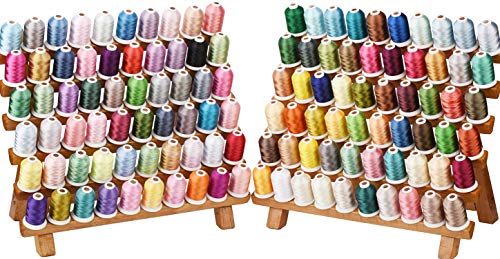
Simthread 120 Color Polyester Embroidery Thread Kit
$71.99A 120 color 40 wt embroidery thread kit.
Check price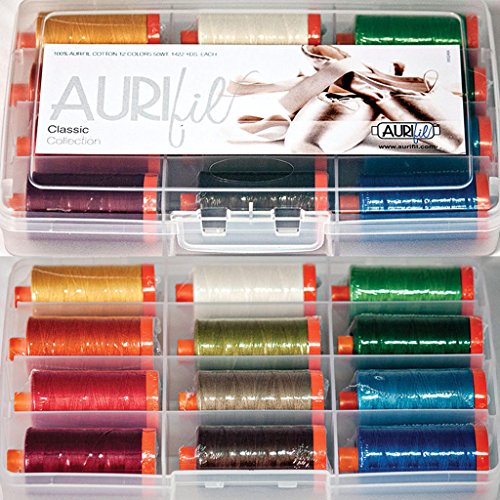
Aurifil Classic Collection 50wt Thread Set
$189.86A boxed Aurifil collection for a well-stocked thread wall.
Check pricePrices change often, so confirm on Amazon. As an Amazon Associate we earn from qualifying purchases.
Frequently asked questions
What does thread weight mean?
Thread weight (wt) is an inverse measure: the higher the number, the finer the thread. In the common weight system, the number is the kilometers of thread that weigh 1 kilogram. 40 wt means 40 km weighs 1 kg (Superior Threads). Because it measures length per unit of weight, a thicker thread covers fewer kilometers per kilogram and gets a lower number.
Is 40 wt or 50 wt thread thicker?
40 wt thread is thicker than 50 wt. Forty weight is the standard for machine embroidery and quilting that you want to see, while 50 wt is finer and sinks into seams, which is why many quilters piece with 50 wt cotton for flat, accurate seams.
What does 50/2 mean on a spool?
Aurifil labels cotton with the Ne (Number English) cotton count: the number of 840 yd hanks that weigh 1 lb. A label like 50/2 means 50 count, 2 plies. In practice, 50/2 cotton behaves like a fine 50 wt thread suited to piecing and machine quilting.
What thread weight is best for machine quilting?
Many quilters use 40 wt when they want quilting to show and 50 wt for a softer, blended look. Fine 60 to 100 wt threads work for dense micro quilting and invisible stitching. Heavy 12 and 28 wt threads suit big-stitch or bold decorative quilting with a topstitch needle.
What needle goes with which thread weight?
As a starting point, 60 to 100 wt threads pair with 60/8 to 70/10 needles, 40 to 50 wt with 80/12 or 90/14, and 12 to 30 wt with 100/16 topstitch needles. The needle eye must let the thread pass freely; shredding or looping usually means a bigger needle is needed.
How we research: we compare manufacturer specifications, owner manuals, published standards and recurring themes in verified owner reviews. We do not test products in person, and this is researched guidance, not professional advice. Follow your machine manual and pattern, and take care with rotary cutters, hot irons and needles. As an Amazon Associate we earn from qualifying purchases.