How Much Yarn Do I Need Calculator: Yards, Skeins and Grams by Project
An adult sweater in worsted weight takes about 1,125 to 1,625 yards knitted or 1,400 to 2,150 yards crocheted. With 10 percent extra and 200 yard skeins, buy 9 skeins to knit it. A worsted throw takes 2,250 to 3,125 yards, about 18 skeins.
Choose a project, knit or crochet, and the yarn weight. Enter the yards on one skein from the label and the calculator gives a yardage range, how many skeins to buy with a cushion, and a grams estimate. These are planning numbers from published yardage guides; if your pattern lists yardage, use the pattern.
Your project
Your results
Estimated yardage
About 1,029 to 1,486 meters
Skeins to buy
| Skeins, no extra | 6 to 9 |
|---|---|
| Weight estimate | 490 to 960 g |
| If crocheted | 1,400 to 2,150 yd |
| Source | Lion Brand yardage guide |
Sweater and baby blanket quantities: wind it once, wind it right
At 800 to 2,500 yards you are handling a bag of skeins. A swift and winder turns hanks into center pull cakes, and value yarn keeps the cost down.

Caron One Pound Yarn, 2 pack
$23.98Two 454 g skeins of worsted acrylic at 812 yards each: two skeins cover most adult sweaters.
Check price
Knit Picks Yarn Winding Bundle, Ball Winder and Birch Swift
$79.99A swift and a 100 g ball winder together, both clamping to tables up to 1.5 inches thick.
Check price
Stanwood Needlecraft 10 oz Metal Ball Winder and Amish Style Swift Bundle
$121.95A 10 oz metal ball winder with an Amish style swift for big hanks and jumbo cakes.
Check pricePrices change often, so confirm on Amazon. As an Amazon Associate we earn from qualifying purchases.
Small projects: good tools for one or two skeins
Hats, cowls, socks and shawls are quick. The tools you use for them are the ones you will reach for on every project after.
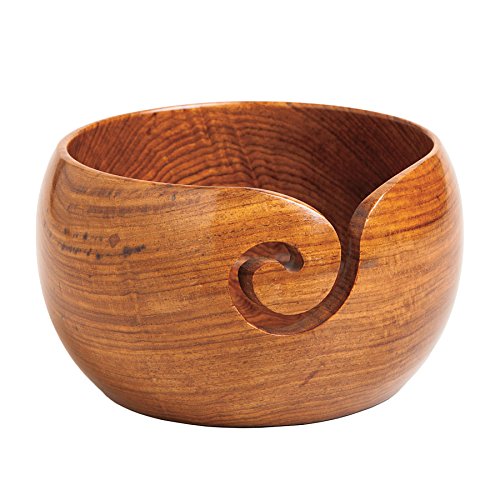
Knit Picks Rosewood Yarn Bowl
$27.00A rosewood yarn bowl that keeps a 100 g cake from rolling away while you work.
Check price Knit Picks Yarn Winding Bundle, Ball Winder and Birch Swift
$79.99Wind hanks of hand dyed sock or shawl yarn into neat cakes in minutes.
Check price
ChiaoGoo Twist Red Lace Interchangeable Set, Complete, 5 inch tips
$216.80Steel tips from US 2 to 15 with swiveling cables, covering every small project gauge.
Check pricePrices change often, so confirm on Amazon. As an Amazon Associate we earn from qualifying purchases.
Thousands of yards? Buy in bulk, and let a machine help
Above 2,500 yards you are in blanket territory. Bulk packs lower the cost per yard, and a crank knitting machine makes long panels fast.

Lion Brand Pound of Love Yarn, bulk 12 pack
$132.90Twelve skeins of worsted in one box, a bulk buy sized for big blankets.
Check price
addi Express Kingsize Knitting Machine, 46 needles
$157.12A 46 needle knitting machine with a 17.7 inch flat mode for blanket panels.
Check price Stanwood Needlecraft 10 oz Metal Ball Winder and Amish Style Swift Bundle
$121.95A 10 oz winder and Amish swift, sized for the jumbo skeins big projects use.
Check pricePrices change often, so confirm on Amazon. As an Amazon Associate we earn from qualifying purchases.
How do you calculate how much yarn you need?
Without a pattern, yardage comes from typical ranges for each project and yarn weight. The calculator looks up that range, then does three small conversions. For the default, an adult sweater knit in medium (worsted) weight with 200 yard skeins:
- Look up the range. A knitted adult sweater in worsted is 1,125 to 1,625 yards in the Lion Brand yardage guide. The low end suits a small, fitted or cropped sweater; the high end a large or long one.
- Add the cushion. Take the top of the range and add 10 percent: 1,625 x 1.1 = 1,788 yards, rounded up.
- Convert to skeins. Divide by the yards on one skein and round up: 1,788 / 200 = 9 skeins. Without the cushion, the range is 6 to 9 skeins.
- Estimate grams. Worsted runs about 170 to 230 yards per 100 grams on retailer charts, so 1,125 to 1,625 yards is roughly 490 to 960 g. The lighter figure pairs the fewest yards with the most yards per gram.
Crochet figures in the data are the knit ranges multiplied by 1.25 at the low end and 1.33 at the high end, which is why the same sweater is 1,400 to 2,150 yards crocheted. That reflects the common finding that crochet uses about a quarter to a third more yarn than knitting for the same size piece.
How much yarn do you need for common worsted weight projects?
Medium weight, often labeled worsted, afghan or aran, is the most common yarn in craft stores, so it is the easiest place to compare projects. Skeins assume 200 yards each with no extra. Projects with their own page link to a deeper breakdown by weight and yarn pack.
| Project | Knit (yd) | Crochet (yd) | 200 yd skeins (knit) | Grams (knit) |
|---|---|---|---|---|
| Adult hat | 200 to 225 | 250 to 300 | 1 to 2 | 90 to 130 g |
| Cowl | 200 to 300 | 250 to 400 | 1 to 2 | 90 to 180 g |
| Mittens (pair) | 150 to 250 | 200 to 325 | 1 to 2 | 70 to 150 g |
| Scarf | 375 to 500 | 475 to 675 | 2 to 3 | 160 to 290 g |
| Adult socks (pair) | 275 to 375 | 350 to 500 | 2 | 120 to 220 g |
| Shawl | 375 to 550 | 475 to 725 | 2 to 3 | 160 to 320 g |
| Adult sweater, small | 800 to 1,000 | 1,000 to 1,325 | 4 to 5 | 350 to 590 g |
| Adult sweater, medium | 1,000 to 1,400 | 1,250 to 1,850 | 5 to 7 | 430 to 820 g |
| Adult sweater, large to XL | 1,400 to 1,800 | 1,750 to 2,400 | 7 to 9 | 610 to 1,060 g |
| Adult sweater (any size) | 1,125 to 1,625 | 1,400 to 2,150 | 6 to 9 | 490 to 960 g |
| Baby blanket | 1,000 to 1,125 | 1,250 to 1,500 | 5 to 6 | 430 to 660 g |
| Throw blanket | 2,250 to 3,125 | 2,825 to 4,150 | 12 to 16 | 980 to 1,840 g |
| Twin blanket | 4,100 to 5,700 | 5,150 to 7,600 | 21 to 29 | 1,780 to 3,350 g |
| Full blanket | 5,000 to 6,900 | 6,250 to 9,200 | 25 to 35 | 2,170 to 4,060 g |
| Queen blanket | 6,250 to 8,650 | 7,800 to 11,500 | 32 to 44 | 2,720 to 5,090 g |
| King blanket | 7,500 to 10,400 | 9,400 to 13,850 | 38 to 52 | 3,260 to 6,120 g |
Notice how quickly blankets outgrow garments. A throw takes roughly twice the yarn of a sweater, and a king size blanket takes several times more. The twin through king rows in the reference data are the throw range scaled by area, so treat them as a guide. For any custom blanket size, the blanket yarn calculator scales from the nearest published size.
Does yarn weight change how much yarn a sweater takes?
A lot. Thinner yarn has more yards in every gram, and it takes more stitches to cover the same body, so the yardage climbs as the yarn gets finer. In weight, though, a sweater comes out closer across the categories than the yards suggest. The table shows the adult sweater range for every weight with published figures.
| Yarn weight | Knit (yd) | Crochet (yd) | Yd per 100 g | Grams (knit) |
|---|---|---|---|---|
| Fine (2) | 1,750 to 2,625 | 2,200 to 3,500 | 300 to 380 | 460 to 880 g |
| Light (3) | 1,500 to 2,250 | 1,875 to 3,000 | 230 to 300 | 500 to 980 g |
| Medium (4) | 1,125 to 1,625 | 1,400 to 2,150 | 170 to 230 | 490 to 960 g |
| Bulky (5) | 950 to 1,125 | 1,200 to 1,500 | 100 to 170 | 560 to 1,130 g |
| Super Bulky (6) | 825 to 1,125 | 1,025 to 1,500 | under 100 | 830 g or more |
Yards per 100 grams are retailer chart ranges, not a Craft Yarn Council standard, and fiber matters. A dense cotton and a lofty wool can share a weight category and still differ widely in yardage. When you shop, compare the yards on the label rather than the category name, and see the yarn weight chart for every weight's gauge and tool sizes.
These are planning estimates
Planning estimates only. The yardage stated on the pattern always wins.
Crochet usually uses about 25 to 33 percent more yarn than knitting for the same size piece.
Why does my project need more yarn than the estimate?
The ranges assume mostly plain fabric at the typical gauge for each weight. Four things push real projects higher:
- Stitch pattern. In one published comparison, garter stitch used about 46 percent more yarn than stockinette for the same size. Cables, bobbles, brioche and textured stitches all add up.
- A looser or tighter gauge. Knitting at a tighter gauge than the label packs more stitches into every inch. If your swatch is off, check it with the knitting gauge calculator before you buy.
- Size and length. Oversized sweaters, long sleeves, tunic lengths and deep ribbing all move you to the top of the range or past it.
- A different yarn than the pattern. If you substitute, compare yards, not skeins. The yarn substitution calculator converts the pattern's total into skeins of your yarn.
The fix is the same in every case: buy the top of the range plus 10 to 15 percent from one dye lot. Dye lots can differ just enough to show as a band across a sweater body, and the shop may not have your lot later.
How do you read a yarn label for yardage?
Every ball band lists two quantities: the weight of the skein in grams or ounces, and its length in yards or meters. The length is the number this calculator needs. If a label only gives meters, multiply by 1.094 to get yards. Many labels also print a recommended needle or hook size and a gauge over 4 inches or 10 cm, plus a number from 0 to 7 inside a small skein symbol. That number is the Craft Yarn Council weight category, the same one used in the weight menu above.
Check the dye lot number while you are there. Skeins with the same color name but different lot numbers can look slightly different side by side, so buy every skein for one project with the same lot printed on the band.
How do you handle big yarn quantities without tangles?
Once a project runs past about a dozen skeins, the prep work starts to matter. Hand dyed and natural fiber yarns often come in twisted hanks that must be wound before you knit, and winding 2,000 yards by hand over a chair back takes an evening. A swift and ball winder turns each hank into a center pull cake in a few minutes. The Stanwood Winder + Amish Swift handles 10 ounce cakes, big enough for jumbo skeins, while the Knit Picks Winder + Swift is the lower cost way in for 100 gram skeins.
For blankets, buying bulk also changes the math: the Caron One Pound 2-Pack puts 812 yards on each skein, so a worsted sweater is two skeins instead of eight or nine, with fewer joins to weave in.
Frequently asked questions
How much yarn do I need for a sweater?
A knitted adult sweater in worsted weight usually takes 1,125 to 1,625 yards, depending on size, length and style. Crocheted, plan on 1,400 to 2,150 yards. In 200 yard skeins that is 6 to 9 skeins to knit, or 9 with a 10 percent cushion. Your pattern lists yardage by size, and that figure always beats a general estimate.
How many skeins of yarn do I need for a throw blanket?
A knitted worsted throw uses about 2,250 to 3,125 yards. Divide by the yards on your skein label and round up: with 200 yard skeins that is 12 to 16 skeins, or 18 with 10 percent extra. For other blanket sizes and a knit versus crochet comparison, use the blanket yarn calculator.
Does crochet use more yarn than knitting?
Yes, usually about 25 to 33 percent more for the same size piece, because crochet stitches are taller and denser. The crochet figures in this calculator are the knit ranges multiplied by 1.25 at the low end and 1.33 at the high end. A worsted adult hat is 200 to 225 yards knitted, which becomes about 250 to 300 yards crocheted.
How do I convert yarn yards to grams?
Divide the yards by the yarn yards per 100 grams, then multiply by 100. Retailer charts put worsted at about 170 to 230 yards per 100 grams, so a 1,625 yard sweater is roughly 490 to 960 g. Fiber changes this a lot: cotton and wool of the same weight can differ widely, so use the label of the yarn you are buying.
How much extra yarn should I buy?
Buy 10 to 15 percent more than the pattern or estimate, from the same dye lot. Dye lots can differ enough to show as a stripe, and a matching lot may be gone by the time you run short. Leftover skeins are useful for swatches, seaming and repairs, and some shops accept returns of unwound skeins. The calculator adds 10 percent by default and you can change it.
Does the stitch pattern change how much yarn I need?
Yes. In one published comparison, garter stitch used about 46 percent more yarn than stockinette for the same size swatch, and cables, textured stitches, bobbles and colorwork all use more than plain fabric. The ranges here are for typical, mostly plain projects. If your pattern is heavily cabled or textured, plan on the top of the range plus your cushion.
How we research: we compare manufacturer specifications, owner manuals, published standards and recurring themes in verified owner reviews. We do not test products in person, and this is researched guidance, not professional advice. Follow your machine manual and pattern, and take care with rotary cutters, hot irons and needles. As an Amazon Associate we earn from qualifying purchases.